Serial Hobbiest
Refused to decide, so I'm doing it all
The Anthropocene Reviewed – Buddy Read Write-up Four (of nine)
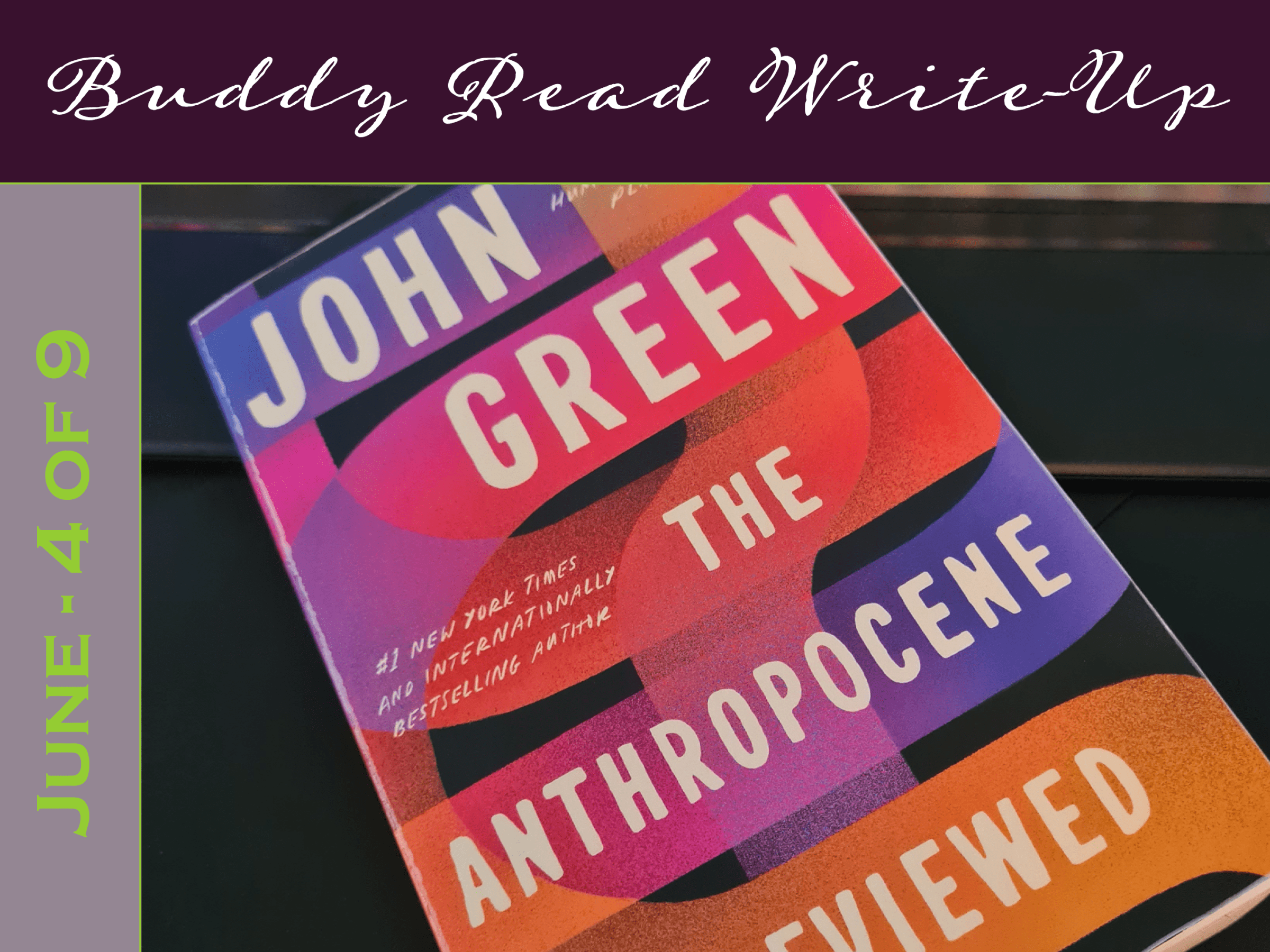
Ok, here, we go. I’m journeying back three months in my mind to write this one.
Marie and I read this batch in June and, while Marie diligently posted her write-up, I have held off. I’m still not convinced that ‘rather late than never’ applies here and seriously considered not posting them at all, but here we go.
This batch contained:
- Academic Decathlon
- Sunsets
- Jerzy Dudek’s Performance on May 25, 2005
- Penguins of Madagascar
- Piggly Wiggly
I think of the essays listed here, my favourite one was probably Academic Decathlon. I like the nostalgic air it had, and the discussion around friendships, and how a fleeting or temporary time in someone’s life can have lasting impact. As someone who moved a lot growing up, leaving towns, schools, cities and countries behind for new beginnings and communities with very little say in the matter, temporary interactions for lasting impact is kind of a norm for me.
This is also one of the few essays where Mr John Green manages to do what he said he would in his introduction, which is to give us more of an insight into him. For a man who says he no longer wanted to write in code, I’m sorry but he seems to be going out of his way to disguise personal anecdotes with meandering facades. No, seriously, coming up in a future batch is an essay about grass. And if you say I’m missing the point and need to read between the lines more, then you are buying the lie, because that, my friend, is writing in code. At this point, I’m just happy to see the odd essay or even paragraph where we’re dealing with the topic at hand in a personable way.
Academic Decathlon circles right back to the very real, very tangible and very recent experience of the pandemic and, frankly, this is what I’m here for. I want to know that others have also had their worries interrupted by new worries (paraphrasing John Green, Anthropocene Reviewed, p. 93). I want to know that others have also been lost in catastrophising thoughts only to have those interrupted by genuine catastrophe. This essay led me back to a feeling of experience on a spectrum and that made it worthwhile.
‘When one of us says, “Look, there’s nothing out there,” what we are really saying is, “I cannot see”.‘
Terry Tempest Williams, as quoted by John Green in The Anthropocene Reviewed
Sunsets on the other hand, was exactly what you might expect from the title. And something neither I nor Marie had really expected of John Green.
This may well be where he lost us. It’s the first topic to get five stars (though certainly not the last) and while the essay starts off seemingly reflecting on when nature is so beautiful it seems fake, which ties in nicely with quite a few other topics up for discussion, this essay reeks of an attempt at magnanimous humility and wisdom. The really frustrating thing is that, when he’s not trying so hard, I think John Green manages just fine as far as insight is concerned; it’s just never felt so forced before.

(Photo credit: jplenio)
‘I miss the luxury of caring about stuff that doesn’t matter’
John Green, Anthropocene Reviewed, and a perfect example of the insight I was referring to before. This, from ‘Jerzy Dudek’s Performance’, an essay I care not much for, is one of my favourite lines from this batch.
Ok, wrapping this up, I will say this, it’s been a wild ride of topics and stressors so far, and I’m beginning to feel them tying together, albeit messily. I look forward to our next discussion despite ultimately giving this batch only 3 out of 5 stars.
As always, Marie and I can be found and followed at:
@serialhobbiest
@serial_readings
@mariereads_books
Marie’s YouTube Channel
 Serial Hobbiest
A great write-up, as always. I like that you highlighted the point that Green is most insightful when he seems to not intend to be. It’s obvious, to me at least, when he’s trying too hard, and that puts me off because it feels like some kind of cousin to emotional manipulation, like he wants me to see things from his point of view and agree with his wisdom. I think part of the reason I like his more personal stories so much is that the same insight comes through them, but in a less forthright way – I’m allowed to find it on my own terms. Maybe we should talk about that at some point.
LikeLike
Yeah, I agree. It may not have been the outward intention, and I can appreciate that, but it’s how it read in this instance.
LikeLiked by 1 person