Serial Hobbiest
Refused to decide, so I'm doing it all
The Anthropocene Reviewed – Buddy Read Write-Up One (of Nine)
Being my very first buddy read, literally ever, I really wasn’t sure what to expect from this one. Turns out, buddy reading with a close friend who also enjoys an in-depth critical analysis of character, theme, plot, message, tone and whatever else we may find within the written words of another human, is one hell of a lot of nerdy fun. The first session and discussion was, as one might imagine, somewhat introductory. We did, after all, get to discuss the Introduction of the book itself. This post may stray towards the introductory as well. Does everyone know Mr John Green? He is pretty famous. I mean, there’s Vlog Brothers, The Fault in Our Stars (now also a movie among other adaptations of his works), his scientifically minded brother, Hank, who created SciShow (I think, wait, let me verify … yep) and his overall charm and relatability.
As for the Anthropocene Reviewed, it is not, in fact, YA. It is [pause for effect] a book of non-fiction essays.

So let’s dive in.
My buddy for The Anthropocene Reviewed, by John Green, is none other than the reflective and articulate Marie, from Marie Reads Books. And, since this is a buddy read, you can find her write-up of our discussion here. On a whole, we seem to share some views and come at others from vastly contradictory perspectives. You can always count on a varied discussion.
All in all, having read exactly four essays, including the introduction, this has been a fascinating experience. Not only because of the novelty within the buddy reading experience, but also because of the content of the work we’re discussing.
Disclaimer: It is unlikely that I will be able to write my stream of consciousness without a few solid spoilers, so if those annoy you, please stop reading immediately. If, however, you are also reading the essays, don’t care about spoilers, or never intend to read the essays at all, have at it.
The topics raised in the first four essays and introduction are, at a surface level, about human experience and existence. Right off the bat, we’re talking about some heavy hitting stuff. It’s like John Green put some of the bigger questions he’s been grappling with to paper and then lightly teased away at them. Not gonna lie, the essay form of writing (essay writing form? form of essay writing?) is suddenly becoming quite appealing because of the bite-sized weavings of profundity.
Ironically, I think Marie and I both preferred the ‘Introduction’ to the essays, though, again unanimously, ‘Humanity’s Temporal Range’ was a decent runner-up.
–
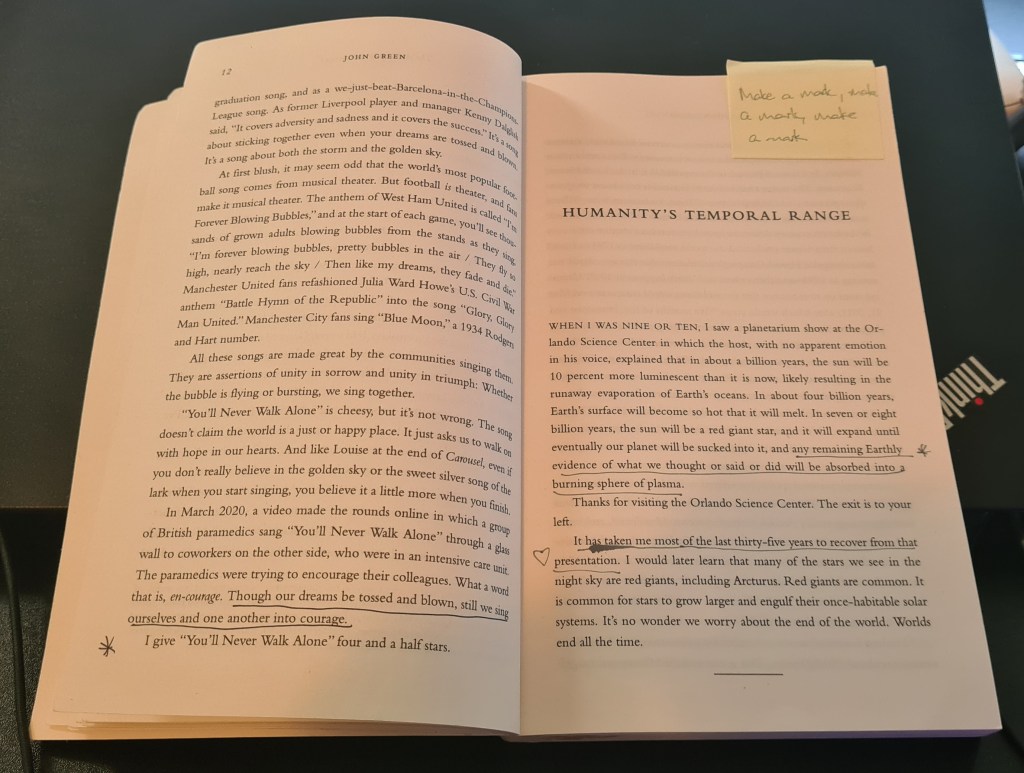
‘Introduction’ and ‘Humanity’s Temporal Range’
Given that this post is already too long, I won’t be writing about each essay individually, but there are a couple of things that Marie and I both highlighted during our discussion and, moreover, a few things that are still playing on my mind.
In the introduction, John Green quite simply speaks to why he’s writing these essays, why he’s decided to step outside of fiction and into the world of fragmented memoir. Marie and I, both being writers, both tackling various projects at various times, both seemed to trip over this idea.
To give an example, Marie’s favourite lines within those first few pages were:
The writer Allegra Goodman was once asked, ‘Whom would you like to write your life story?’ She answered, ‘I seem to be writing it myself, but since I’m a novelist, it’s all in code.’
‘Introduction’, The Anthropocene Reviewed, by John Green
My favourite line was:
As I recovered from labyrinthitis, I reali[s]ed I didn’t want to write in code anymore.
‘Introduction’, The Anthropocene Reviewed, by John Green
I swear there’s much more to the introduction than this notion of obscurely embedding yourself in your writing, but it hit a chord for both of us.
The ‘Introduction’ also introduces a couple of topics, at least one of which has always been riddled with anxiety for me personally. It rolls together with a lot of the environmental challenges we’re currently facing, as well as the more vast perspective on life, the meaning of life, an individual’s impact on life and the idea of ‘leaving a mark’ in what is clearly a temporary existence. For anyone who occasionally slips down that rabbit hole, I highly recommend ‘Humanity’s Temporal Range’.
Despite dealing with themes that are simply outside of our control, this essay was soothing. It spoke to the different anxieties around the uncontrollable and stepped in with calming effect.
So far, I would say that the Anthropocene Reviewed is definitely worth a look. And to lean right into the thing we’re doing here, I give the first five essays (including ‘Introduction’) three and a half stars, with ‘Introduction’ and ‘Humanity’s Temporal Range’ bringing up the average with their four and four and a half star ratings.
Wrapping up this initial write-up, let us know if you’d like to have access to the original discussion, as it happened, since we did record the thing. 😊 And, if you haven’t found her already, Marie’s Instagram handle is @mariereads_books
 Serial Hobbiest
As expected, your write up is so much better than mine lol. I’m still hoping that by next month I’ll have figured out exactly how I want to write about this thing we’re doing.
LikeLiked by 1 person
Ha! I was thinking the same about yours! I’m sure we can muddle our way through.
LikeLiked by 1 person
Pingback: The Anthropocene Reviewed – Month 1 – Marie Reads Books
Pingback: The Anthropocene Reviewed – Buddy Read Write-Up Two (of Nine) – Serial Hobbiest